
Collin Morikawa’\”s Ball Striking Technique: Precision Personified
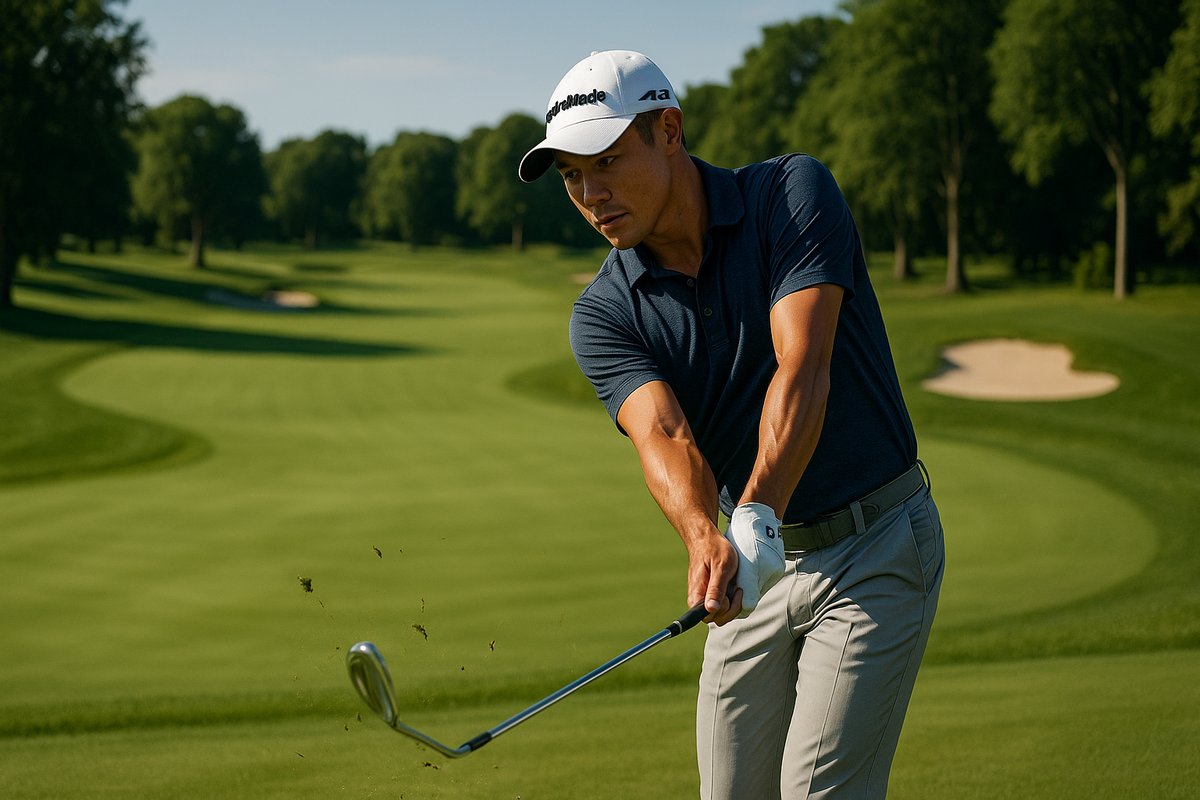
Collin Morikawa’s swing is that compact, no-nonsense motion you see week in and week out. What keeps his ball striking so dialed in isn’t one trick—it’s a stack of fundamentals layered so tight that even when he’s a hair off, he’s still peppering fairways and greens like he’s got a launch monitor in his head. I’ve played enough rounds to know that kind of repeatability doesn’t happen by accident.
The guy posts around 75 percent greens in regulation, which puts him right up there with the elite iron players on Tour. That’s the payoff from a swing built on solid basics and executed with mechanical consistency.
His setup is narrow, feet about shoulder-width, with light but firm grip pressure. The club sits just inside the target line at address, giving him a little room on the way back. Posture shows that subtle forward shaft lean with the irons—nothing dramatic, but it delofts the face and steepens the attack angle for those penetrating shots. Stance stays square, ball position a touch forward with irons to promote the descending blow. With woods it shifts toward the front shoulder, but never overdone. Boring? Sure. But it eliminates variables before the swing even starts.
What makes Morikawa’s address position particularly effective is his grip alignment. His hands sit slightly ahead of the ball with irons, which naturally creates compression at impact without requiring explosive hand action. This is something recreational golfers often overthink—they try to force compression through timing rather than building it into their setup. Morikawa’s grip pressure remains constant throughout the swing, never tightening under pressure or loosening during the backswing. That stability allows his hands to work as a unit with his forearms, eliminating the wrist manipulation that creates inconsistency.
Backswing stays short and controlled, club finishing roughly parallel or just short. Takeaway is low and connected, left arm extended without locking, hands quiet through waist height. No big lag pressure like the bombers chase—his angle sits neutral to slightly compressed, which trades a few yards for that iron control he needs. Lower body loads clean, right knee flexed, hips turning about 45 degrees against 90 in the shoulders. Separation without excess movement.
The efficiency of Morikawa’s backswing deserves deeper examination. While many players on tour create longer swings to generate club head speed, Morikawa achieves similar velocity through sequencing precision. His club moves on a relatively flat plane, which allows him to stay connected and prevents the disconnection that creates path errors. The shortness of his swing also means less time for compensations to creep in. When you’re only turning for roughly three-quarters of a second on the way back, there’s minimal opportunity for your lower body to get ahead of your upper body or your hands to outpace your torso rotation.
His lead arm maintains approximately 90 degrees of flexion at the top, never fully extending. This creates a more compact position and reduces reliance on flexibility—a critical advantage for a player who needs consistency across multiple tournaments and varying physical conditions. The club’s position relative to his body at the top sits directly above his shoulder plane, not laid off or across the line, which positions him perfectly for the downswing.
Transition is where it all clicks. Lower body leads, hips clearing just ahead of the torso, dropping the club into the slot instead of throwing it. Head stays stable, eyes locked on the ball. By thigh height the club is inside the line, no over-the-top move. Wrists hold their hinge, building speed smoothly into impact where the hands lead, body clears, and the face meets the path square. Attack angle stays neutral to slightly down with irons.
The sequencing Morikawa employs in his downswing exemplifies Tour-level timing. His weight shift begins immediately, with pressure moving into his front foot before his hands even start moving down. This gives his body time to clear while his hands lag naturally rather than fighting the rotation. By the time his hands reach hip height on the downswing, his hips have already rotated about 30 degrees open to his address position. This creates the slot—that ideal position where the club approaches from inside the target line with a square face.
What’s particularly instructive is how Morikawa’s shaft lean increases into impact. Many amateurs either lose shaft lean (scooping) or create excessive lean that over-compresses the ball. Morikawa’s forward lean at impact sits around 6-8 degrees with irons, which is sufficient to create a crisp strike without the ball ballooning or losing distance. His angle of attack mirrors this consistency—typically between 3-5 degrees down with mid-irons, steeper with long irons, shallower with short irons.
Follow-through tells the story—tall, balanced, weight fully on the front side, hips facing the target. No lunging or spinning out. Watch him hit ten irons in a row and the finish positions look nearly identical. That repeatability is gold under pressure. His finish position shows complete weight transfer with his back foot completely released, coming up on the toe naturally. His torso faces left of target (for a right-hander), not facing straight down the line, which indicates proper rotation rather than lateral sliding.
It shows up in the numbers too. Morikawa sits among the leaders in strokes gained approach because he keeps the ball in play off the tee and sticks greens. He’s not leaning on short-game heroics—he’s putting for birdie more often than scrambling. His approach shot consistency translates directly into lower scoring. When you’re hitting 75 percent of greens, you’re avoiding the penalty of missing greens and giving yourself far more scoring opportunities.
Looking at his ball flight patterns, Morikawa typically produces a slight draw or straight ball flight depending on the club and conditions. This is achieved through his neutral path and square face delivery. His irons typically sit around a 90 mile-per-hour ball speed with a mid-iron, generating about 15 degrees of launch angle—perfectly balanced for control and carry distance. These launch characteristics allow for varying distances with the same swing motion, just by club selection, rather than trying to manufacture different swing speeds.
As a former club pro, I can tell you the setup and sequencing here are what recreational players can actually steal: neutral posture, forward shaft lean with irons, controlled takeaway, and proper lower-body initiation. Skip trying to copy the abbreviated backswing if your flexibility isn’t there—focus on cutting variables instead. Start with your address position and grip. Spend time at the range ensuring your hands are ahead of the ball and your posture creates a slight forward tilt. Then work on sequencing—feel your lower body starting the downswing before your hands follow. This sequencing principle matters far more than matching Morikawa’s exact backswing length.
The reality of Morikawa’s success is that it comes from years of disciplined practice and refinement. His technique wasn’t created overnight, and it continues to evolve slightly as tour conditions change and his body develops. But the foundation—solid setup, efficient motion, and absolutely repeatable sequencing—remains the blueprint for ball striking excellence at the highest level.